Sweet flag, also called calamus, is a hardy perennial with sword-shaped leaves like an iris. Crush a leaf and it smells of citrus and spice. It grows in mud and shallow water where most garden plants rot. Two plants share the name. Acorus calamus came from Europe and Asia and now grows wild across the eastern states. Acorus americanus is the native American sweet flag. Both suit pond margins, bog gardens and wet ditches. Difficulty: easy, as long as the roots never dry out.
Sowing and planting
Most sweet flag starts as a division, which is a piece of rhizome with roots and a fan of leaves. The Acorus calamus found in North America rarely sets seed, so division is the only practical way to raise it. The native Acorus americanus does set seed. Buy nursery-grown plants rather than digging wild ones, so wetland colonies stay intact.
Plant in spring once the water starts to warm, or in early autumn at least six weeks before your first hard frost. Choose a spot in full sun if you can. Part shade works, but clumps grow thinner and lean towards the light.
At a pond edge, set the rhizome horizontally in the mud. Cover it so it sits just below the surface, with the leaf fan pointing up. Keep the crown (the point where leaves meet rhizome) no deeper than 6 inches (15 cm) under water. Shallower is better for young plants.
In a lined pond, use an aquatic basket. Fill it with heavy garden loam or clay soil. Avoid bagged potting mix, which floats away and fouls the water. Top the soil with 1 inch (2.5 cm) of pea gravel to hold it down. Lower the basket onto a shallow shelf.
No pond? Sweet flag grows well in a bog garden or a large pot with no drainage holes. Keep the soil saturated at all times. A low spot by a downspout or a wet ditch also suits it.
To grow the native species from seed, sow fresh seed on the surface of wet soil in autumn. Leave the pot outdoors over winter, standing in a tray of water. The cold period helps germination. Seedlings appear in spring and look like fine grass at first.
Growing on
Water is the whole job. Soil that dries out for even a few days browns the leaf tips and stalls growth. In a bog bed or pot, top up during dry spells and check daily in hot weather.
Feeding is rarely needed. Pond mud and garden loam carry enough nutrients. Extra fertilizer in a pond feeds algae instead of your plants. For a tired basket plant, push one aquatic fertilizer tablet deep into the soil in spring. Follow the label rate.
Sweet flag needs no staking. Leaves stand upright on their own in sun. A small greenish-yellow flower spike, called a spadix, sometimes juts out at an angle from a leaf-like stalk in early summer. It is a curiosity rather than a show. Plants in shade or deep water often skip flowering.
Leaves die back after hard frost. Cut them down to 2 inches (5 cm) above the crown in late autumn or late winter. Lift the dead foliage out of the pond so it does not rot in the water.
Clumps spread steadily but not aggressively. Divide them every three to four years to keep them vigorous. In zones 4 and 5, lower pond baskets below the ice line for winter, or sink potted plants into the ground.
Harvesting
Do not eat, brew or chew any part of sweet flag. The US Food and Drug Administration prohibits calamus and its extracts as food additives because of beta-asarone, a compound linked to cancer in animal tests. Grow it as an ornamental only.
Mountain families once saw this plant very differently. Anthony Cavender's Folk Medicine in Southern Appalachia records calamus root as a favoured stomach remedy. People chewed it raw or boiled it as a tea, and some carried a piece in a pocket. It also went into teas given to colicky babies. That is history, not advice. Nothing here is medical advice, and these uses are not safe to copy.
What you can harvest today is scent and new plants. Cut a few outer leaves at the base in summer for their fragrance. Households once strewed them on floors to freshen a room. A handful in a vase or tied in a bundle does the same job. Wear gloves if you have sensitive skin.
The main harvest is divisions. In spring, as new growth starts, lift the clump or basket. Rinse off the mud so you can see the rhizome. It is pinkish-brown outside, white inside, and as thick as a thumb. Cut it into pieces 3 to 4 inches (8 to 10 cm) long with a clean, sharp knife. Take care with the blade on a wet, slippery root. Each piece needs roots and at least one leaf fan. Trim the leaves by half and replant straight away. Discard old, soft, leafless sections from the centre.
Problems and pests
Sweet flag has few enemies. Deer and rabbits usually leave it alone because of the scented foliage. Most trouble traces back to water or light.
Brown, crisp leaf tips
The soil has dried out, or the pot is too small to stay wet. Soak it at once and move it to a wetter spot. Cut off damaged tips with scissors for looks.
Floppy, sparse growth with no flowers
Too much shade or water that is too deep. Move the plant to a sunnier shelf and raise the crown to within a few inches of the surface.
Rusty or dark spots on leaves
Fungal leaf spots and rust appear in crowded, humid clumps. Remove spotted leaves and bin them rather than composting. Divide congested plants to let air through. Spraying is not worthwhile, and fungicides do not belong near pond water.
A clump that dies out in the middle
This is old age, not disease. Lift, divide and replant the young outer pieces.
The wrong plant
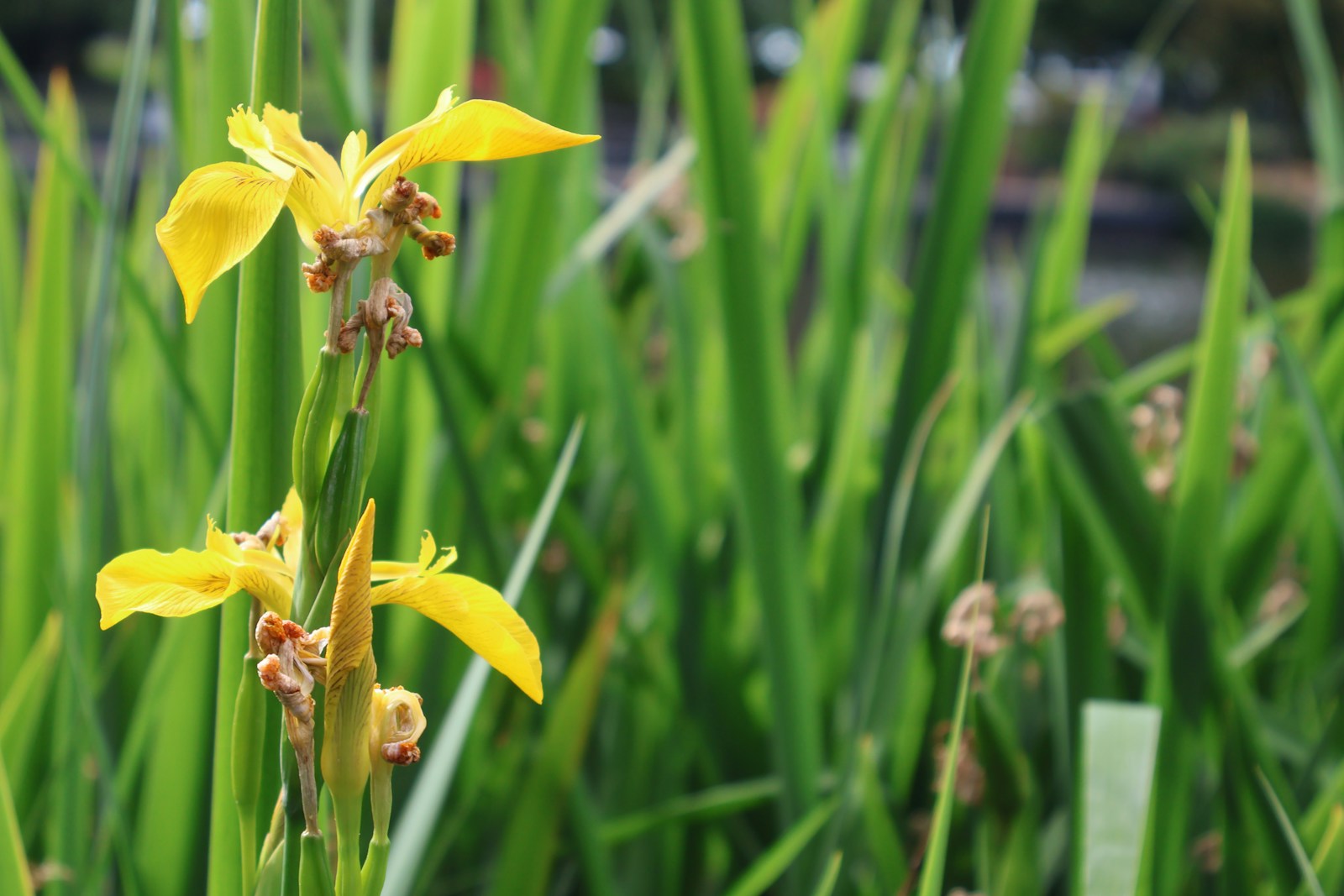
Yellow flag iris looks similar out of flower and is invasive in many states. Check before you buy or accept a gift plant. Sweet flag leaves have an off-centre midrib and often a crinkled edge. They smell sweet and spicy when crushed. Iris leaves have no scent.
Varieties worth growing
Sweet flag has very few named cultivars. Only one is widely sold, so this list includes the native species and a clearly labelled relative.
- 'Variegatus' (Acorus calamus): leaves striped lengthwise in cream and green, flushed pink in spring. Slower and a little shorter than the plain form.
- Plain green sweet flag (Acorus calamus): the vigorous species itself. The best choice for covering a long wet bank.
- American sweet flag (Acorus americanus): the native species, very similar in looks. Choose it for wildlife ponds and wetland plantings, and buy from a native plant nursery.
- Japanese sweet flag 'Ogon' (Acorus gramineus, a related species): a golden-striped dwarf about 10 inches (25 cm) tall. It suits small containers and is hardy in roughly zones 6 to 9.
- Japanese sweet flag 'Variegatus' (Acorus gramineus, a related species): the same compact habit with white-striped leaves.
The same rule applies to every plant on this list. Enjoy the foliage and keep it out of the kitchen.