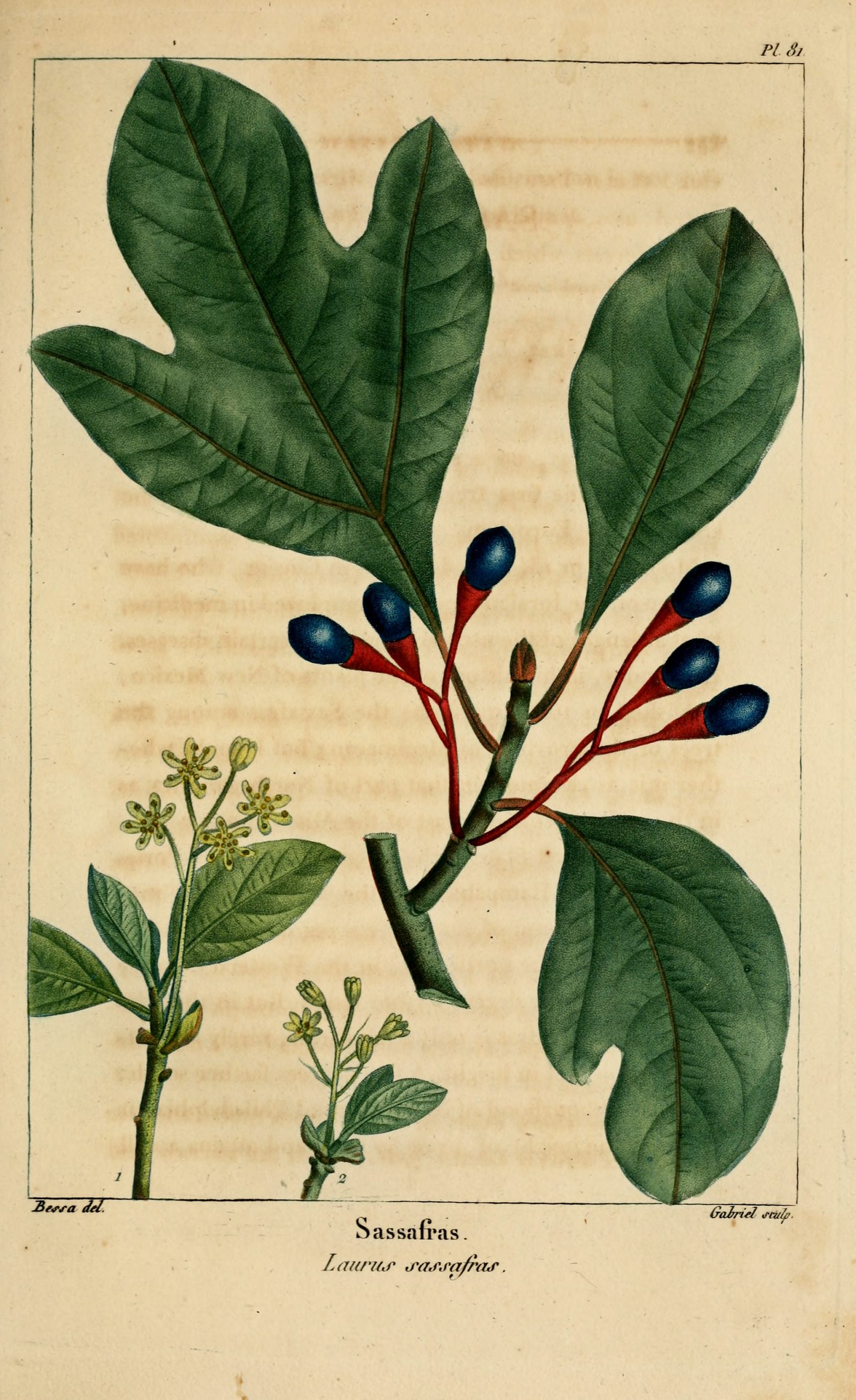
Sassafras (Sassafras albidum) is a native tree of eastern North American woods, fencerows and old fields. One branch carries three leaf shapes: a plain oval, a mitten and a three-lobed "ghost". Fall color runs from yellow through orange to deep red. You grow it for beauty, wildlife and history rather than for the kitchen. It is easy to grow once established, but tricky to transplant.
Quick facts
| Feature | Detail |
|---|---|
| Family | Laurel family (Lauraceae) |
| Sun | Full sun to part shade |
| Water | Moderate; tolerates dry spells once established |
| Soil | Acidic, well-drained, loamy or sandy |
| Mature size | Usually 30 to 60 feet (9 to 18 m) tall |
| Spacing | 25 to 40 feet (7.5 to 12 m) for single trees |
| Days to harvest | Not applicable (grown as a tree) |
| Hardiness | USDA zones 4 to 9 |
Sowing and planting
Sassafras grows a deep taproot (a single main root that heads straight down). That root resents disturbance, so large trees rarely survive a move. Buy a small, container-grown tree from a native plant nursery. A sapling 1 to 3 feet (30 to 90 cm) tall settles in far better than a bigger one.
Do not dig saplings from the wild. Most "seedlings" around a mature tree are really suckers (shoots rising from the parent's roots). They have few roots of their own and usually die when moved.
Plant in early spring, once the ground can be worked, or in fall while the soil is still warm. Choose the spot with care, because you cannot easily move the tree later.
- Pick a site with at least half a day of sun and soil that drains well.
- Dig a hole as deep as the pot and two to three times as wide.
- Slide the root ball out gently. Do not tease or cut the taproot.
- Set the tree so the top of the root ball sits level with the ground.
- Backfill with the soil you dug out, water deeply, and mulch.
Sassafras needs acidic soil. In alkaline ground (soil with a high pH, often over limestone), the leaves turn yellow and the tree struggles. If rhododendrons, blueberries or oaks thrive nearby, your soil is likely suitable.
You can also grow sassafras from seed, though it takes patience. Only female trees bear fruit, since sassafras is dioecious (male and female flowers grow on separate trees). Collect the dark blue fruits in late summer when they ripen, and clean off the pulp. Sow them outdoors in fall, about half an inch (1 cm) deep. Winter cold breaks the seed's dormancy, and seedlings appear in spring. Indoors, you can mimic this with cold stratification (storing seed in damp sand in a refrigerator) for about three to four months.
Growing on
Water a new tree deeply once a week through its first two growing seasons, whenever rain is lacking. After that, sassafras handles ordinary dry spells on its own.
Keep a mulch ring of shredded leaves or bark 2 to 3 inches (5 to 8 cm) deep. Hold the mulch a few inches back from the trunk to prevent rot. Feeding is rarely needed. In decent soil, an annual layer of leaf mulch supplies enough.
The main ongoing task is deciding what to do about suckers. Left alone, sassafras spreads by its roots into a grove of many stems. This thicket looks wonderful at a woodland edge and gives birds cover. For a single-trunk specimen, cut suckers at ground level each year, or mow around the tree. Expect more suckers if the roots are damaged by digging or tilling.
Prune in late winter while the tree is dormant. Remove dead, crossing or broken branches. Young trees sometimes form two competing leaders (main upright stems). Choose the stronger one and remove the other. Wear eye protection and gloves, and leave any work that needs a ladder or a chainsaw to a qualified arborist.
Growth is fairly quick when the tree is young, often 1 to 2 feet (30 to 60 cm) a year in good conditions. The branches grow in horizontal tiers, giving older trees an attractive layered outline in winter.
Harvesting
Sassafras is not a crop tree. What you gather from it is mostly pleasure: spring flowers, summer shade, fall color and the spicy scent of a crushed leaf or scratched twig.
Small yellow-green flowers open in early spring, just before the leaves. On female trees, dark blue fruits follow in late summer, each held on a bright red stalk. Birds strip them fast. The leaves also feed the caterpillars of the spicebush swallowtail butterfly, so expect a few chewed or folded leaves and leave them be.
Sassafras has a long folk history in the southern mountains. Anthony Cavender's Folk Medicine in Southern Appalachia records that mountain families drank root bark tea as a spring tonic. They believed it thinned and cleaned the blood after a winter of heavy food. Families also chewed the ends of peeled sassafras twigs into simple toothbrushes. The roots and bark were gathered for the herb trade for generations. Root bark once flavored traditional root beer as well. These uses are history, not recommendations, and nothing here is medical advice.
Sassafras root bark contains safrole. The US Food and Drug Administration banned safrole and sassafras oil as food additives after animal studies linked safrole to liver cancer. Do not make tea or flavorings from the roots or bark.
Dried, powdered young sassafras leaves are the traditional source of filé, a thickener used in Louisiana gumbo. If you want filé for cooking, the safe general course is to buy it from a food supplier rather than process your own tree.
Problems and pests
Leaves turn yellow while veins stay green
This is chlorosis, usually caused by alkaline soil that locks up iron. There is no quick cure for a tree in the wrong soil. Mulch with leaf litter or pine needles, and avoid lime or wood ash nearby. Test your soil pH before you plant.
Shoots appear all over the lawn or bed
These are root suckers, a normal habit of the tree. Mow them or cut them at ground level every year. Avoid digging near the tree, since wounded roots send up more shoots. If this habit does not suit your yard, plant sassafras at a wild edge instead.
Leaves chewed to lace in summer
Japanese beetles skeletonize sassafras leaves in some areas. On a small tree, knock beetles into a bucket of soapy water in the cool of the morning. Established trees usually shrug off the damage without treatment.
Sudden wilting, with brown leaves that hang on
This may be laurel wilt, a fatal fungal disease carried by the redbay ambrosia beetle. It has spread through parts of the southeastern United States. There is no practical home cure. Contact your local extension office for identification and disposal guidance. Do not move firewood from affected trees.
A newly planted tree fails to leaf out
Transplant shock from a damaged taproot is the usual cause. Start again with a smaller container-grown sapling, handle the root ball gently, and water steadily through the first two years.
Varieties worth growing
Named sassafras cultivars are rare, and you are unlikely to find any at a nursery. The plain species is what gardeners grow, and it needs no improvement. Buy a nursery-propagated seedling, ideally grown from seed collected in your own region.
If you want to build a planting around sassafras, these native companions suit similar sites. They are separate species, not sassafras varieties.
- Spicebush (Lindera benzoin): a related shrub in the laurel family with fragrant twigs, yellow fall color and red berries. It also hosts the spicebush swallowtail.
- Pawpaw (Asimina triloba): an understory tree that also forms suckering groves, with large leaves and edible fruit.
- Black gum (Nyssa sylvatica): a taprooted native tree with fall color to rival sassafras, and fruit that birds love.
- Serviceberry (Amelanchier species): small trees with white spring flowers and early summer berries for the woodland edge.