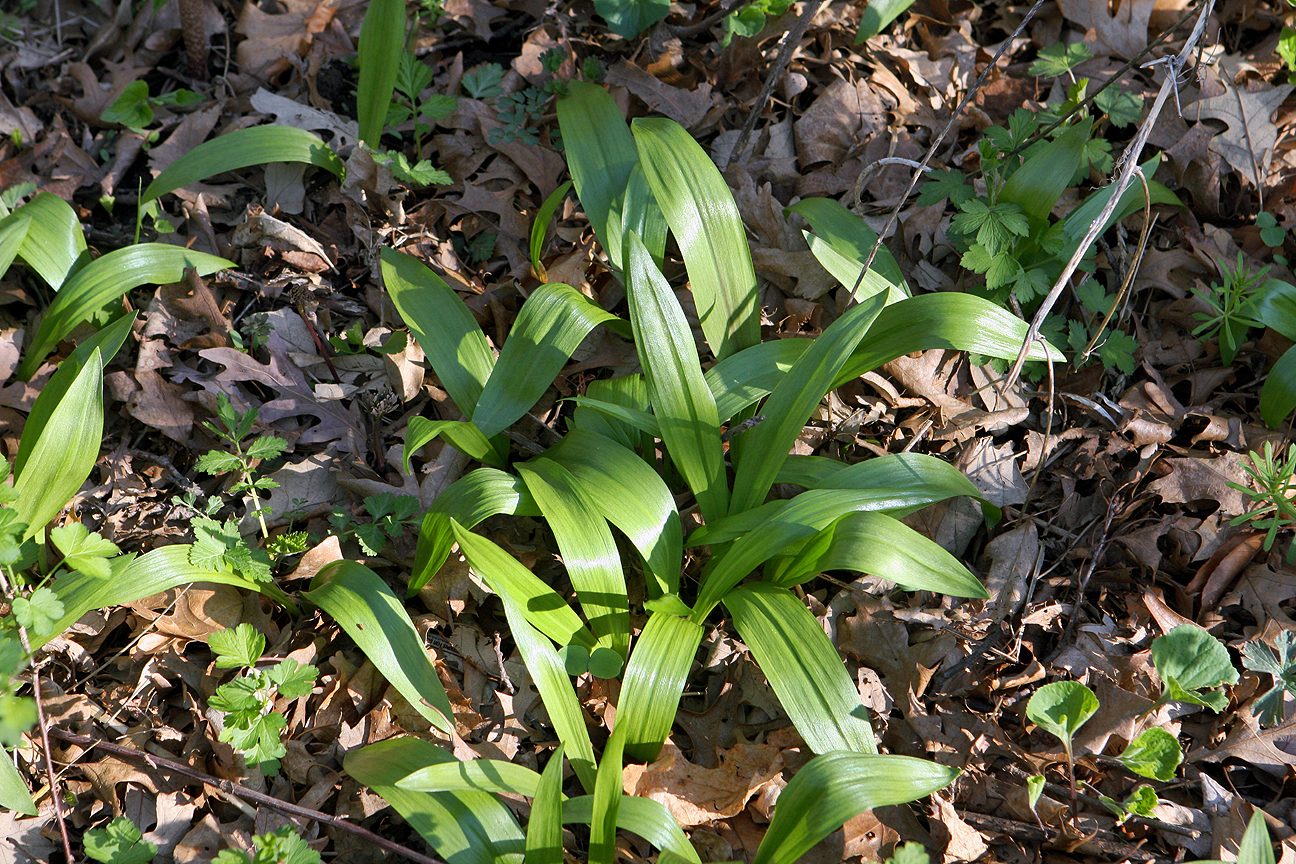
Ramps (Allium tricoccum), also called wild leeks, are native woodland onions of eastern North America. Each bulb sends up two or three broad, smooth leaves in early spring. The flavor sits between garlic and onion. They suit the shady ground under hardwood trees where few other crops grow. Ramps are easy to keep alive but very slow, so patience is the main skill.
Ramps have deep roots in mountain culture. Southern Appalachian families treated the first ramps as a spring tonic after a winter of stored food. Anthony Cavender's Folk Medicine in Southern Appalachia records that they were eaten with other early greens in the belief that they cleaned and thinned the blood. That is folk history, not medical advice. Grow ramps for the kitchen.
Quick facts
| Feature | Detail |
|---|---|
| Family | Amaryllidaceae (onion family) |
| Sun | Full to partial shade under deciduous trees |
| Water | Evenly moist soil, never waterlogged |
| Spacing | 4 to 6 inches (10 to 15 cm) |
| Time to harvest | 5 to 7 years from seed, 2 to 3 years from bulbs |
| Hardiness | USDA zones 3 to 7 |
Wild ramp populations are shrinking because of heavy digging, and harvest is restricted on many public lands. Never dig wild plants to start your patch. Buy nursery-propagated bulbs or seed instead.
Sowing and planting
Choose the site first, because ramps stay put for decades. They are spring ephemerals, meaning plants that grow in early spring sun and go dormant once the tree canopy closes. The best spot lies under deciduous trees such as maple, beech, tulip poplar or hickory. The north or east side of a building can work if the soil is right. Avoid ground under conifers, which is usually too dry and acidic.
The soil needs to be moist, loose and rich in organic matter. Think of forest floor: dark, crumbly and covered in rotting leaves. If your soil is thin, work in plenty of leaf mold (fully rotted leaves) or compost before planting. Good drainage matters as much as moisture.
Bulbs are the quicker route. Plant them in early spring as soon as the ground thaws, or in autumn after the leaves have died back. Set each bulb about 3 inches (8 cm) deep with the tip just at the soil surface. Space them 4 to 6 inches (10 to 15 cm) apart. Water well, then cover with 2 to 3 inches (5 to 8 cm) of shredded hardwood leaves.
Seed is cheaper but needs real patience. Ramp seed has a double dormancy. It needs a warm, moist spell to grow a root and then a cold spell before a shoot appears. Sow fresh seed in late summer or early autumn so nature supplies both. Rake back the leaf litter and press seeds onto the soil surface about 1 inch (2.5 cm) apart. Then replace the leaf cover. Seedlings can take from six to eighteen months to show. The first leaf is a single thin blade that is easy to mistake for grass, so mark the bed clearly.
Growing on
Ramps need little care once the site suits them. Your main job is to keep the bed like a forest floor.
- Mulch: Let autumn leaves lie, or add a fresh layer of shredded hardwood leaves each year. The mulch holds moisture, feeds the soil and protects bulbs from frost heave. Avoid thick mats of whole oak leaves, which small seedlings struggle to push through.
- Water: Water during dry spells in spring while the leaves are green. The bulbs are dormant in summer but still dislike bone-dry soil. Give the bed a deep soak in a long drought.
- Feeding: Rotting leaves usually supply all the nutrition ramps need. Skip strong fertilizers.
- Weeding: Hand-pull weeds while they are small. Do not hoe, because the bulbs sit close to the surface.
Expect a strange growth cycle. Leaves appear in early spring and yellow by late spring. A bare flower stalk follows in early summer with a round cluster of white flowers. Shiny black seeds ripen by late summer. Leave them to drop and the patch thickens on its own. Bulbs also divide slowly underground. You can lift and split crowded clumps in early spring, and replant them at once.
Harvesting
Wait until the patch is well established before you pick anything. For planted bulbs, that usually means the third spring at the earliest. Seed-grown plants need five to seven years to reach full size.
Harvest leaves rather than bulbs. Cut one leaf from each mature plant and leave the rest to feed the bulb. Use a sharp knife and cut just above the soil. The leaves carry the full flavor, and the plant comes back next year. This method lets you pick from the same patch every spring.
If you want a few bulbs, take them only from dense clumps. Lift no more than about one plant in ten in any year. Ramps recover very slowly from bulb harvest, so lighter is always better. Pick in early to mid spring while the leaves are fresh and fully open. Leaves wilt fast, so keep them cool and use them within a few days.
Problems and pests
Leaves yellow and collapse in late spring
This is normal dormancy, not disease. The plant has finished its yearly growth. Leave the foliage to die back naturally and mark the spot.
Leaves scorch or the patch shrinks each year
The site is too sunny or too dry. Ramps need shade once the weather warms. Move bulbs in early spring to a spot with a full summer canopy, and deepen the leaf mulch.
Ragged holes in young leaves
Slugs and snails feed on new growth in wet springs. Pick them off at dusk and clear boards or stones where they hide. Damage is usually cosmetic on established plants.
Wavy, distorted leaves with lines of pale dots
This points to allium leafminer, a small fly whose larvae tunnel in onion-family plants. Cover the bed with fine insect netting from late winter until the leaves die back. Remove and bin badly affected leaves.
Bulbs rot
Soft, smelly bulbs mean waterlogged soil. Ramps want moisture with drainage. Replant healthy bulbs on a gentle slope or in a bed raised with leaf mold.
A note on lookalikes: Lily of the valley and false hellebore have similar leaves and are poisonous. True ramps always smell strongly of onion when a leaf is torn. If there is no onion smell, do not eat it.
Varieties worth growing
Ramps have no named garden cultivars. Your choice lies between two natural forms and a few close relatives.
- Common ramp (Allium tricoccum var. tricoccum): The classic form, with wide leaves and burgundy-red lower stems. It is the largest and the one most nurseries sell.
- Narrow-leaf ramp (Allium tricoccum var. burdickii): A smaller plant with slimmer leaves and white stems. It has a milder flavor and tolerates slightly drier woodland soil.
- Nodding onion (Allium cernuum): A native relative for sunnier spots where ramps fail. It gives edible leaves and pink flowers, and it grows much faster.
- Ramsons (Allium ursinum): The European woodland counterpart with a similar garlicky leaf. It can spread strongly, so keep it contained and away from natural woodland.