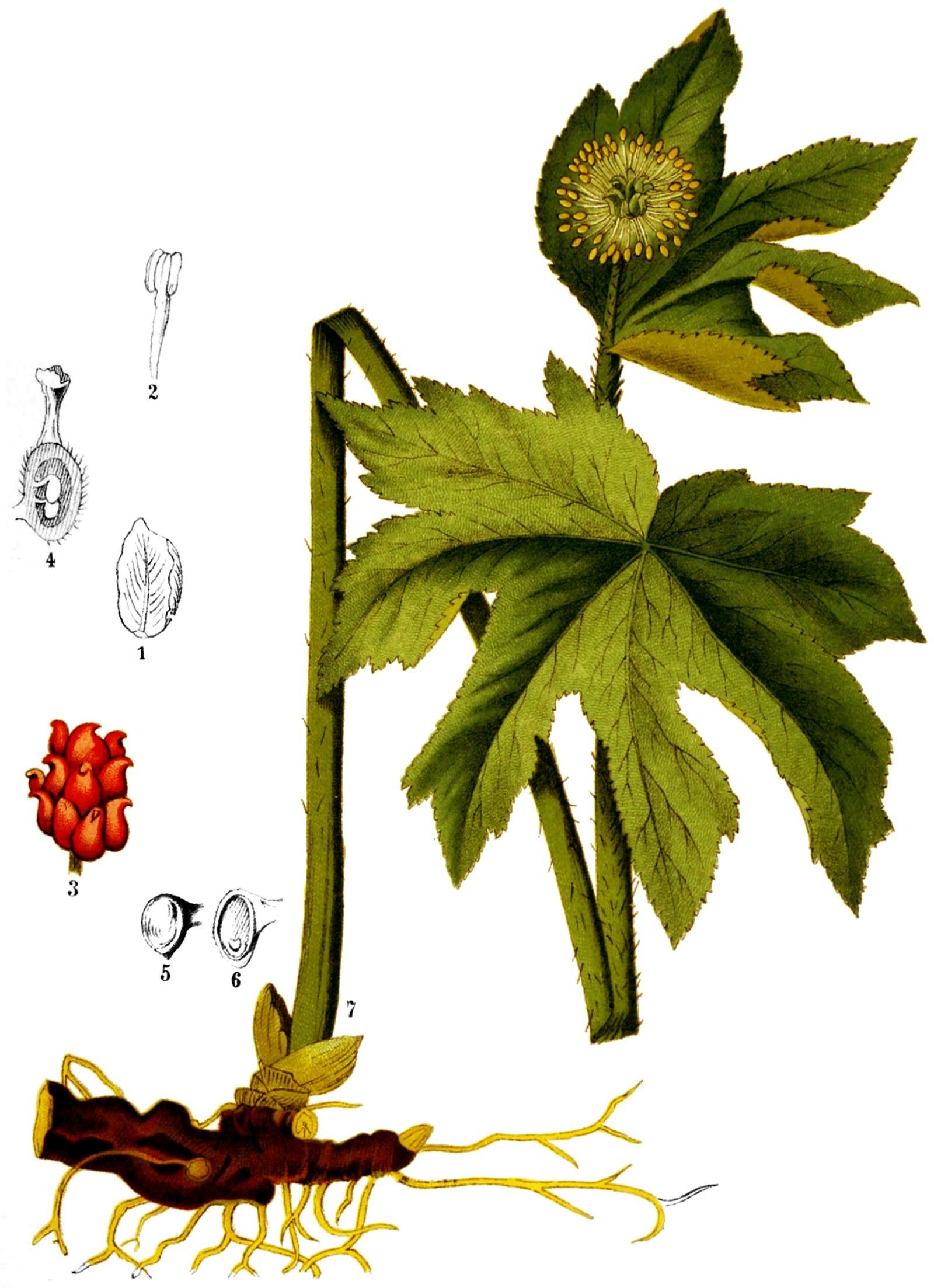
Goldenseal (Hydrastis canadensis) is a low woodland perennial native to the rich hardwood forests of eastern North America. Each stem carries two broad, wrinkled leaves shaped a little like a maple leaf. A small white flower with no petals opens in spring. A single red fruit that looks like a raspberry follows in summer. Below ground is a knotty rhizome (a thick underground stem), bright yellow inside.
Grow it as a handsome ground cover for deep shade, or to help keep an over-collected native in cultivation. It spreads into a colony on its own. Difficulty: easy to moderate, once the shade and soil are right.
Quick facts
| Feature | Detail |
|---|---|
| Family | Ranunculaceae (the buttercup family) |
| Sun | Full to heavy shade, roughly 70 to 80 percent |
| Water | Evenly moist, well-drained soil |
| Spacing | 6 to 12 inches (15 to 30 cm) |
| Time to harvest | Roots at 3 to 5 years from rhizome pieces |
| Hardiness | USDA zones 3 to 8 |
Plants grow 6 to 14 inches (15 to 35 cm) tall. The tops die back in autumn, sometimes earlier in a dry summer, and return each spring.
Sowing and planting
Pick a spot under tall deciduous trees, such as maple, tulip poplar, oak or hickory. The soil should be loose and dark, full of rotted leaves, and moderately acid to near neutral. It must hold moisture but never stay waterlogged. A gentle slope helps drainage. If wild woodland plants such as mayapple, trillium or bloodroot already grow there, goldenseal usually thrives too.
No woodland? Build a raised bed on the shady side of a building or under a shade structure. Mix in plenty of leaf mould (rotted leaves) or fine composted bark.
Do not dig goldenseal from the wild. It has been over-collected across its range and is protected or listed as at risk in many states. Buy nursery-propagated plants, rhizomes or seed, and check your state's rules before you harvest or sell any root.
You have three ways to start.
Rhizome pieces. This is the most reliable method. Plant in autumn, once the tops die back, or in early spring before growth starts. Each piece needs at least one bud and some fibrous roots. Set it with the bud pointing up, about 1 to 2 inches (2.5 to 5 cm) below the surface. Space pieces 6 to 12 inches (15 to 30 cm) apart. Water well, then cover the bed with 2 to 3 inches (5 to 8 cm) of shredded leaves.
Potted plants. Plant these in spring or autumn at the same depth they sat in the pot. Disturb the roots as little as you can.
Seed. Seed is slow and patchy. It must never dry out, so buy fresh, moist seed or collect your own from ripe red fruit. Wash off the pulp and sow at once, in late summer or early autumn, about 1/2 inch (1 cm) deep. Cover with a light layer of leaves. Some seed sprouts the next spring, and some waits another year. Seedlings stay tiny in their first season, with a pair of round seed leaves only.
Growing on
Goldenseal asks for little once it is established.
- Watering. Water new plantings through their first summer whenever the top inch (2.5 cm) of soil dries. Older beds in good woodland soil need water only in drought. Water at the base to keep leaves dry.
- Feeding. No fertiliser is needed. A fresh layer of fallen or shredded leaves each autumn feeds the soil as it rots.
- Mulch. Keep a leaf mulch in place all year. It holds moisture and protects buds over winter. Pull it back a little in spring if it has matted, so shoots can push through.
- Weeding. Weed by hand. The rhizomes and their fine roots sit close to the surface.
- Support and pruning. Neither is needed. Let the leaves yellow and collapse naturally, since they feed next year's buds.
A healthy patch thickens over time. The fibrous roots produce new buds, so a single plant slowly becomes a clump, then a colony.
Harvesting
Rhizomes planted as pieces are usually ready after 3 to 5 years. Plants raised from seed take longer, often 5 to 7 years. Dig in autumn, after the tops start to die back, when the rhizome is at its heaviest.
Loosen the soil with a garden fork, starting 6 inches (15 cm) out from the stems. Lift the whole mat of rhizomes and roots. Shake off loose soil and rinse with a hose. Do not scrub, since the fine roots break easily.
Replant as you go. Cut or break off the smaller pieces with good buds and set them straight back into the bed. This way the patch renews itself and you never need to buy stock again.
Dry the rest on screens in a warm, shaded, airy place. Turn them every day or two. The root is dry when it snaps cleanly and shows bright yellow inside. Wear gloves when handling fresh rhizomes, because the yellow sap stains skin and cloth.
Goldenseal has a long place in Appalachian folk history. According to Anthony Cavender's Folk Medicine in Southern Appalachia, mountain families steeped the root as a gargle for sore throats. Some ground it to a powder and blew it to the back of the throat through a goose quill. People carried a piece of root in a pocket to chew for an upset stomach. It also went into bitter spring tonics, eyewashes and salves. Families dug it to sell to herb dealers as well, which is one reason wild stands are now scarce.
These uses are reported as history only. This article is not medical advice. Goldenseal contains strong alkaloids, so do not treat it as a home remedy, and speak to a doctor before using any herb. Do not eat the red fruit.
Problems and pests
Brown, spreading patches on leaves in wet weather
Leaf blights, often caused by the grey mould fungus Botrytis, strike crowded beds in damp, still air. Thin the planting and clear away fallen tops in autumn. Water at soil level only. The rhizome usually survives and regrows.
Plants wilt and rhizomes turn soft
Root rot comes from poor drainage. Lift healthy pieces and move them to higher, looser ground. Discard rotten pieces in the bin, not the compost heap.
Ragged holes in young leaves
Slugs feed on spring growth. Hand pick them after dark and pull thick, wet mulch away from emerging shoots.
Stunted plants with small swellings on the roots
Root-knot nematodes (microscopic soil worms) cause these galls. There is no garden cure. Start a new bed elsewhere with clean stock, and do not move soil from the old bed.
Roots gnawed or plants pushed out of the ground
Voles tunnel through mulched beds and chew rhizomes. Moles disturb roots while hunting worms. Keep grass short around the bed and firm any lifted plants back in at once.
Varieties worth growing
Goldenseal has no named cultivars. Only the one species exists, so your choice is about planting stock.
- Rhizome pieces with buds give the fastest, surest start and are the usual choice for a new bed.
- Potted nursery plants suit a small ornamental patch and can go in during spring or autumn.
- Fresh moist seed is the low-cost route for a large planting, if you accept a longer wait.
- Regionally grown stock from a nursery near you tends to be well adapted to your climate.
For a fuller woodland bed, plant it beside other nursery-grown natives that like the same shade, such as black cohosh, bloodroot and wild ginger.