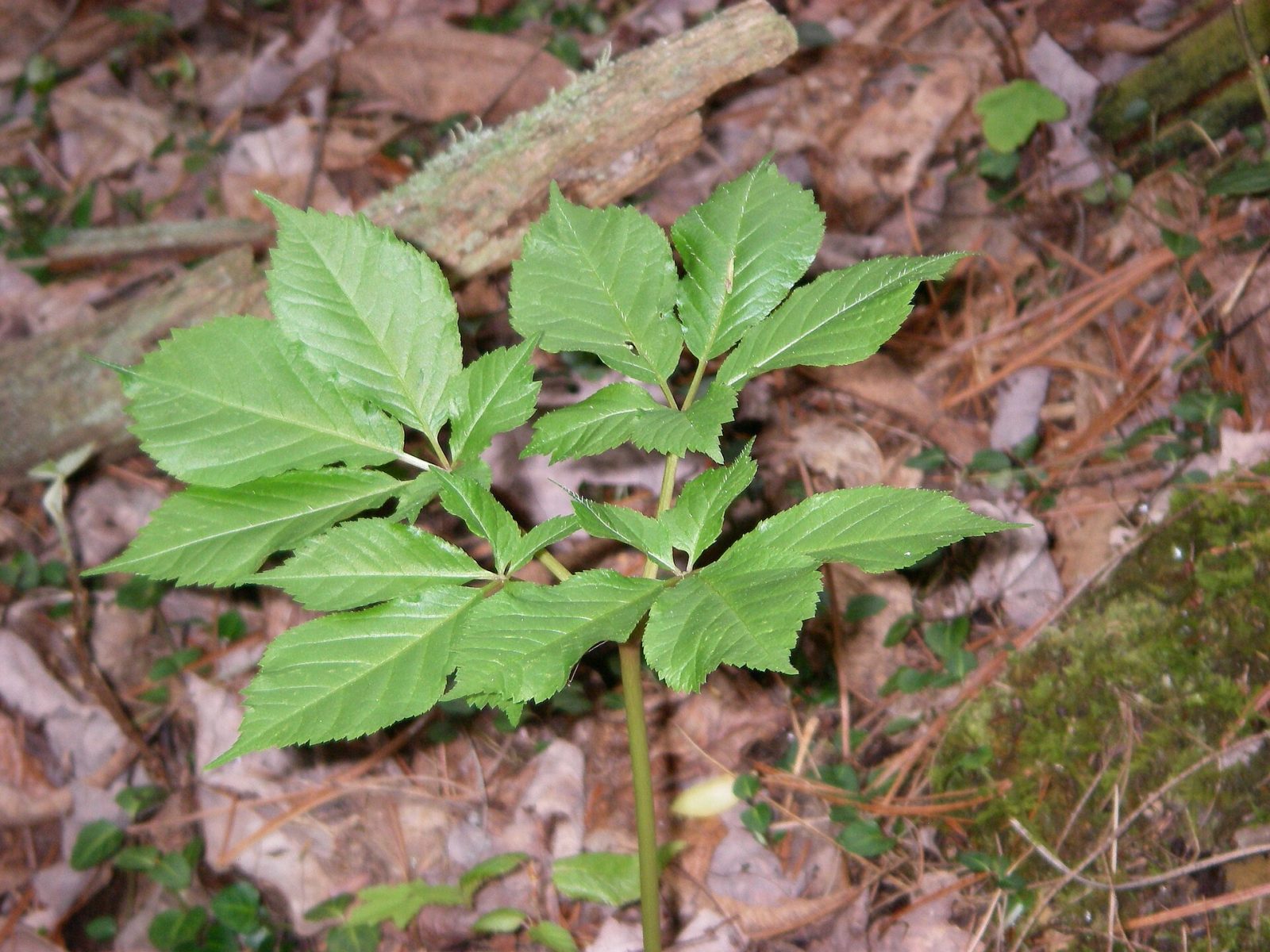
American ginseng (Panax quinquefolius) is a small woodland perennial native to the hardwood forests of eastern North America. It grows a single stem topped with a whorl of leaves, each with five toothed leaflets. Greenish flowers in summer give way to a cluster of bright red berries. The part people prize is the pale, forked root.
Grow it if you have a shady patch under deciduous trees and plenty of patience. It asks for little work, but it is slow. Difficulty: moderate, mostly because the site has to be right and the wait is long.
Quick facts
| Feature | Detail |
|---|---|
| Family | Araliaceae (the ivy and aralia family) |
| Sun | Deep shade, roughly 70 to 90 percent |
| Water | Evenly moist, never soggy; well-drained soil |
| Spacing | 6 to 12 inches (15 to 30 cm) |
| Time to harvest | Roots at 5 to 10 years |
| Hardiness | USDA zones 3 to 7, zone 8 in cool shade |
Mature plants stand about 8 to 24 inches (20 to 60 cm) tall. They die back to the ground each autumn and return in spring.
Sowing and planting
Choose the site first, because it matters more than anything you do later. Ginseng wants the shade of tall deciduous trees such as maple, tulip poplar, beech or oak. A gentle slope facing north or east is ideal, since it stays cool and drains well. The soil should be loose, dark and rich in leaf mould (rotted leaves). Wild neighbours such as ferns, trilliums and jack-in-the-pulpit are a good sign. Avoid wet hollows and heavy clay.
Never dig ginseng from the wild. Wild populations are in decline, and harvest and sale are regulated by states. Buy nursery-propagated roots or seed, and check your state's rules before you harvest or sell any root, even from your own land.
You can start with seed or with rootlets (one- to three-year-old nursery roots).
Seed. Ginseng seed has a long dormancy and needs a period of cold, moist storage called stratification before it sprouts. Buy seed sold as stratified. Sow it in autumn, after the leaves begin to fall and before the ground freezes. Rake back the leaf litter, scatter or place the seed, and cover it about 1/2 to 1 inch (1 to 2.5 cm) deep. Pull the leaves back over the top. Seedlings appear the following spring. Never let the seed dry out before sowing. A separate guide covers growing from seed in depth.
Rootlets. These save you a year or more. Plant them in autumn or in early spring while they are dormant. Set each root at a slant or on its side, with the bud at the top about 1 inch (2.5 cm) below the soil surface. Space plants 6 to 12 inches (15 to 30 cm) apart. Wider spacing lets air move and slows the spread of disease. Cover the bed with 1 to 2 inches (2.5 to 5 cm) of shredded leaves.
If you have no woodland, a raised bed under a shade structure can work. The shade must be heavy and the soil must drain freely.
Growing on
Ginseng needs very little from you once it is settled.
- Watering. In a good woodland site, rain is usually enough. Water only in a long dry spell, and water the soil, not the leaves. Wet foliage invites disease.
- Feeding. Skip fertiliser. Rich feeding pushes soft growth that rots easily. A yearly layer of fallen leaves is all the food it needs. Some growers add gypsum to raise soil calcium without changing acidity, but do this only after a soil test suggests it. Ginseng prefers a moderately acid soil, around pH 5 to 6.
- Mulch. Keep the natural leaf layer in place all year. It holds moisture, keeps roots cool and protects the buds in winter. Do not pile it deeper than about 2 inches (5 cm), or the shoots struggle to emerge.
- Weeding. Pull weeds by hand. The roots sit shallow and a hoe damages them.
- Support and pruning. None needed. Leave the stems alone until they yellow and fall on their own.
Growth is slow. A first-year seedling has a single leaf with three leaflets. Over the years it adds more leaves, which growers call prongs. Plants with three or four prongs are mature and flower each summer.
Harvesting
Roots are usually dug after 5 to 10 years. Older roots are larger and more valued. Dig in autumn, once the berries are red and the leaves begin to yellow. Waiting for ripe berries lets you replant them first. Squeeze the seeds from the pulp and plant them nearby, 1/2 to 1 inch (1 to 2.5 cm) deep, to keep the patch going.
Use a garden fork or a narrow spade. Start well out from the stem, about 6 inches (15 cm), and loosen the soil all round. Lift the whole root gently, because broken side roots and a snapped neck spoil it. Wash it briefly in cool water without scrubbing. Dry the roots in a single layer on screens, in a warm, airy room out of the sun. Drying takes from one to several weeks depending on size. A dry root snaps cleanly.
You can also pick the ripe berries each year for seed without ever digging a root.
In Appalachian folk history, ginseng mattered more as a cash crop than as a home remedy. Mountain families dug "sang" and sold it to dealers, and for some it was one of the few sources of cash. Anthony Cavender's Folk Medicine in Southern Appalachia records the root as a traditional blood tonic and as one ingredient in teas given to infants. These uses are reported here as history only. This article is not medical advice, and you should speak to a doctor before using any herb.
Problems and pests
Brown spots with a yellow halo on leaves, then early dieback
This is usually Alternaria leaf blight, a fungal disease that spreads in warm, humid weather. Space plants widely and keep leaves dry. Remove and bin affected tops. The root often survives and resprouts next spring.
Plants wilt and the root turns soft and dark
Root rot follows poor drainage. There is no cure for an affected plant. Remove it with the surrounding soil and stop planting in that spot. Choose sloping ground and never add rich compost or manure.
Seedlings collapse at soil level
Damping off (a fungal rot of young stems) strikes crowded seedlings in wet spring weather. Sow thinly and keep the mulch light over new seed beds.
Ragged holes in leaves or missing seedlings
Slugs feed at night on young growth. Hand pick them after dark and keep the mulch layer thin in spring.
Tops eaten off or roots missing
Deer browse the leaves, and voles and mice eat roots and seed. Fence against deer where they are common. Keep the patch away from dense grass, which shelters voles. Sadly, theft by people is also a real risk, so keep your planting out of sight and quiet.
Varieties worth growing
American ginseng has no named garden cultivars. What you choose instead is the type of planting stock and a few close relatives.
- Stratified seed is the cheapest way to start a large patch, and it is ready to sprout the spring after autumn sowing.
- Nursery rootlets cost more per plant but shorten the wait and show results in the first spring.
- Locally sourced stock from a grower in your own region tends to suit your climate and keeps local plant genetics intact.
- Asian ginseng (Panax ginseng) is the East Asian relative. It needs similar shade but is rarely offered to home gardeners in North America.
- Dwarf ginseng (Panax trifolius) is a tiny native spring wildflower. Grow it for its white flowers, not for its root.